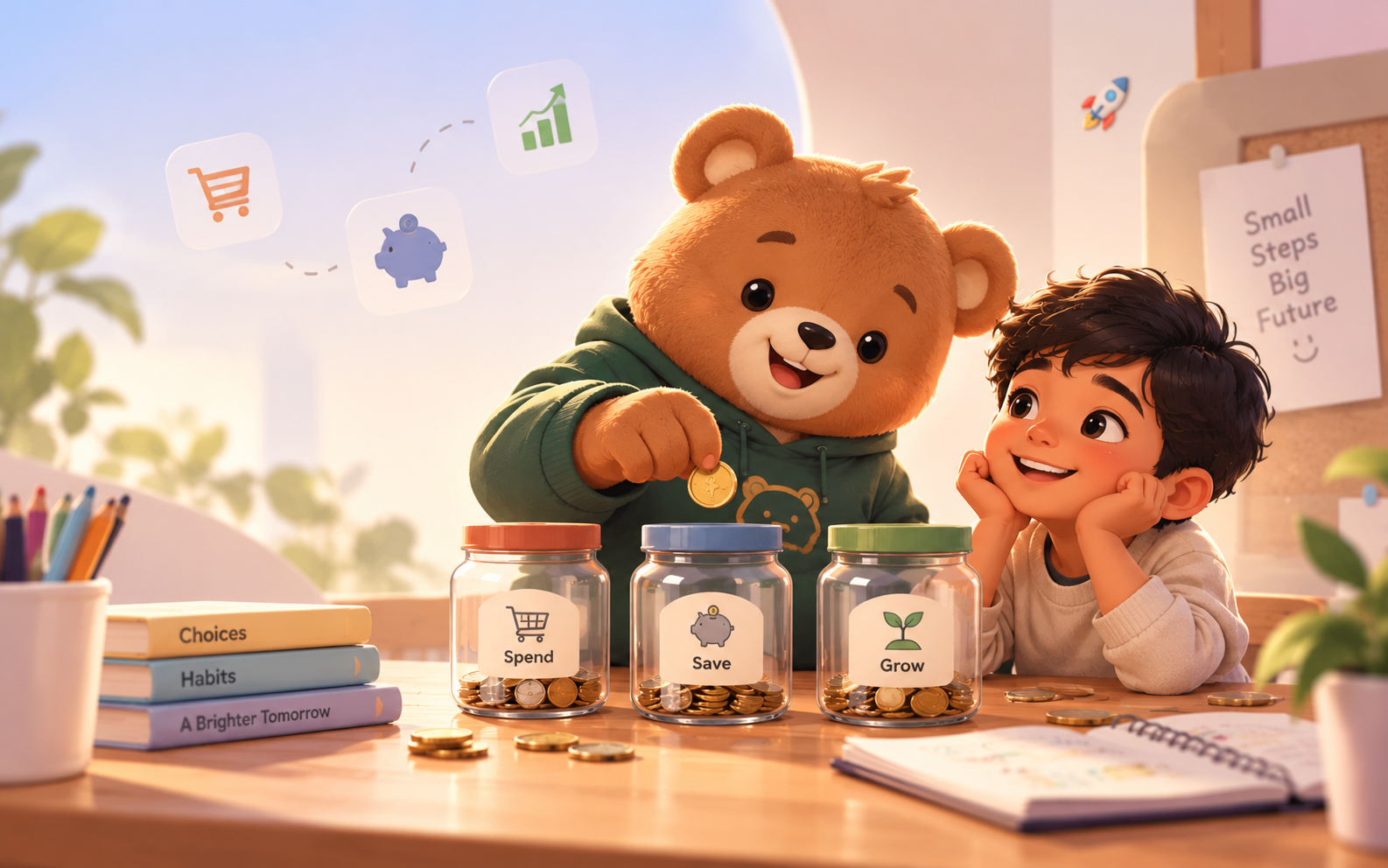
Spend, Save, Share: The Three-Jar Method for Teaching Kids Money
Three jars, three jobs for money: spending, saving and sharing. A simple system that teaches children budgeting, patience and generosity at once.
If you want one simple system to start your child's money education, the three-jar method is hard to beat. It needs no apps, no bank account, and no financial knowledge. Just three containers and a little consistency.
The idea is that every bit of money your child receives gets divided into three purposes: spending, saving, and sharing. Over time, this simple habit teaches budgeting, patience, and generosity all at once.
Why three jars work
Young children think in concrete terms. Telling a six-year-old to “budget” means nothing. Showing them three jars, each with a label and some coins inside, makes money visible and easy to understand.
The jars also solve a common problem: all-or-nothing thinking. Without a system, children tend to either spend everything immediately or hoard it without a purpose. The jars teach that money can do different jobs at the same time.
The three jars explained
Spend jar. This is money your child can use freely, on small treats, toys, stationery, or anything they like within your family's rules. The key is that it is genuinely theirs to decide. If they waste it, that is part of the lesson.
Save jar. This money is for a specific goal that costs more than they can afford right now. A new cricket bat, a board game, a set of books. The jar fills slowly, and the wait teaches patience.
Share jar. This money is for giving. It might go to a donation box at a place of worship, a local charity, a gift for a friend's birthday, or helping someone in need. It teaches that money is not only for ourselves.
How to split the money
There is no fixed rule. Many families start with an equal three-way split because it is easy for young children to understand. Others put a larger share into spending for younger kids and shift more towards saving as children grow.
A few common approaches:
- Equal split. One-third to each jar. Simple and fair.
- Spend-heavy. Half to spend, the rest split between save and share. Good for very young children who need to enjoy money to stay interested.
- Save-heavy. A larger portion to save, with smaller amounts to spend and share. Better for older children working toward bigger goals.
Let your child have a say in the split. When they choose it, they are more likely to stick with it.
Setting it up
- Find three clear jars or boxes. Transparent containers work best, because children can watch the money grow.
- Label them together. Let your child decorate the labels. Ownership makes the system feel like theirs.
- Agree on the split. Write it on a small card and stick it near the jars.
- Divide every amount immediately. Pocket money, gifts, earnings from chores. Everything goes through the jars on the day it arrives.
- Pick a goal for the save jar. Put a picture of the goal on the jar if you can.
Making the share jar meaningful
The share jar is often the one families forget about, but it may be the most important. Let your child decide where the money goes. They might want to buy food for a stray dog, contribute to a school donation drive, or buy a small gift for a grandparent.
When children choose the cause themselves, giving becomes something they care about rather than a rule they follow.
What happens when the spend jar is empty?
It will happen. Your child will spend everything and then want something else. This is the moment that tests the system. Avoid borrowing from the save jar or topping up the spend jar. Instead, talk about what happened and what they might do differently next time.
These small disappointments are where the real learning happens.
Moving from jars to a digital record
Physical jars are wonderful for young children. But as children get older, and as more money becomes digital, coins in jars stop matching how money actually works. Gifts arrive through payment apps, relatives send money online, and cash becomes less common.
This is a natural point to move the same idea into a digital form. The principle stays the same: every coin gets a purpose.
Pocket Cub is built around this kind of thinking. You keep the real money, and Pocket Cub keeps the record, so your child can see their money divided into goals and purposes, the same way the jars worked, but in a format that grows with them.
A habit that lasts
Adults who manage money well often use a version of the jar method without realising it: a portion for spending, a portion for savings, a portion for giving or family support. Children who start with three jars at age six are practising the same habit that will serve them for life.
Three jars, a few coins, and a little patience. It is one of the simplest and most effective money lessons you can give.